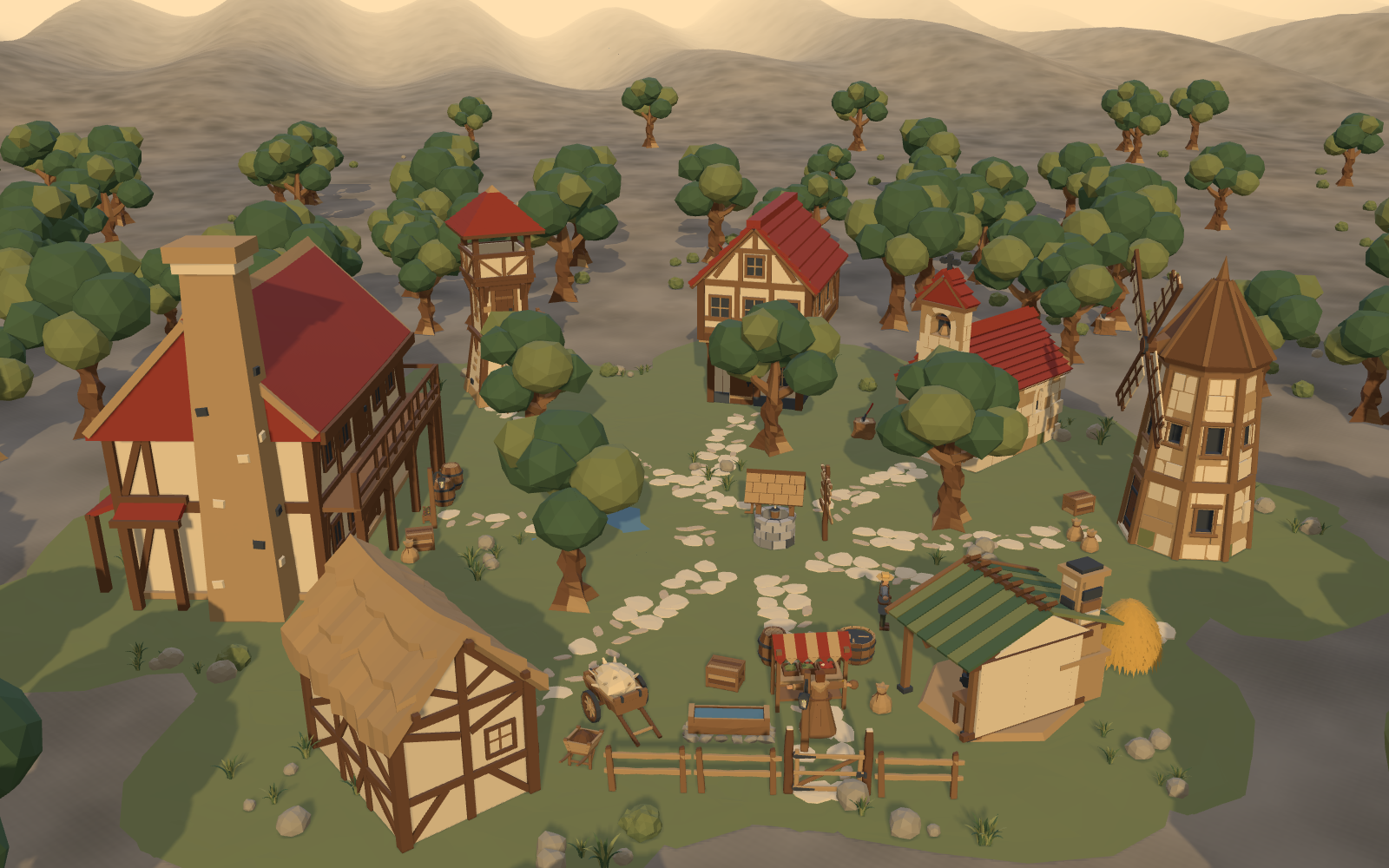
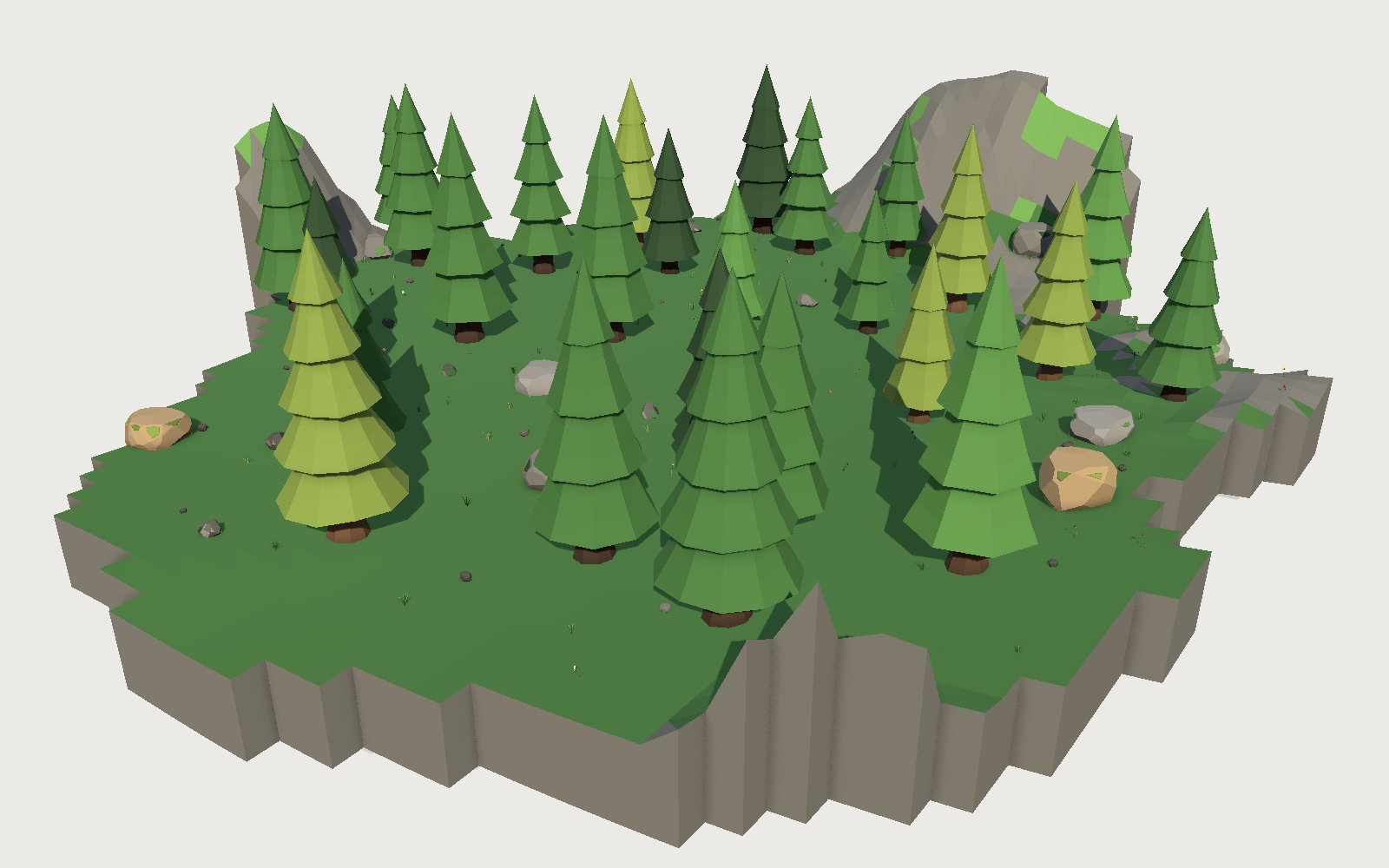
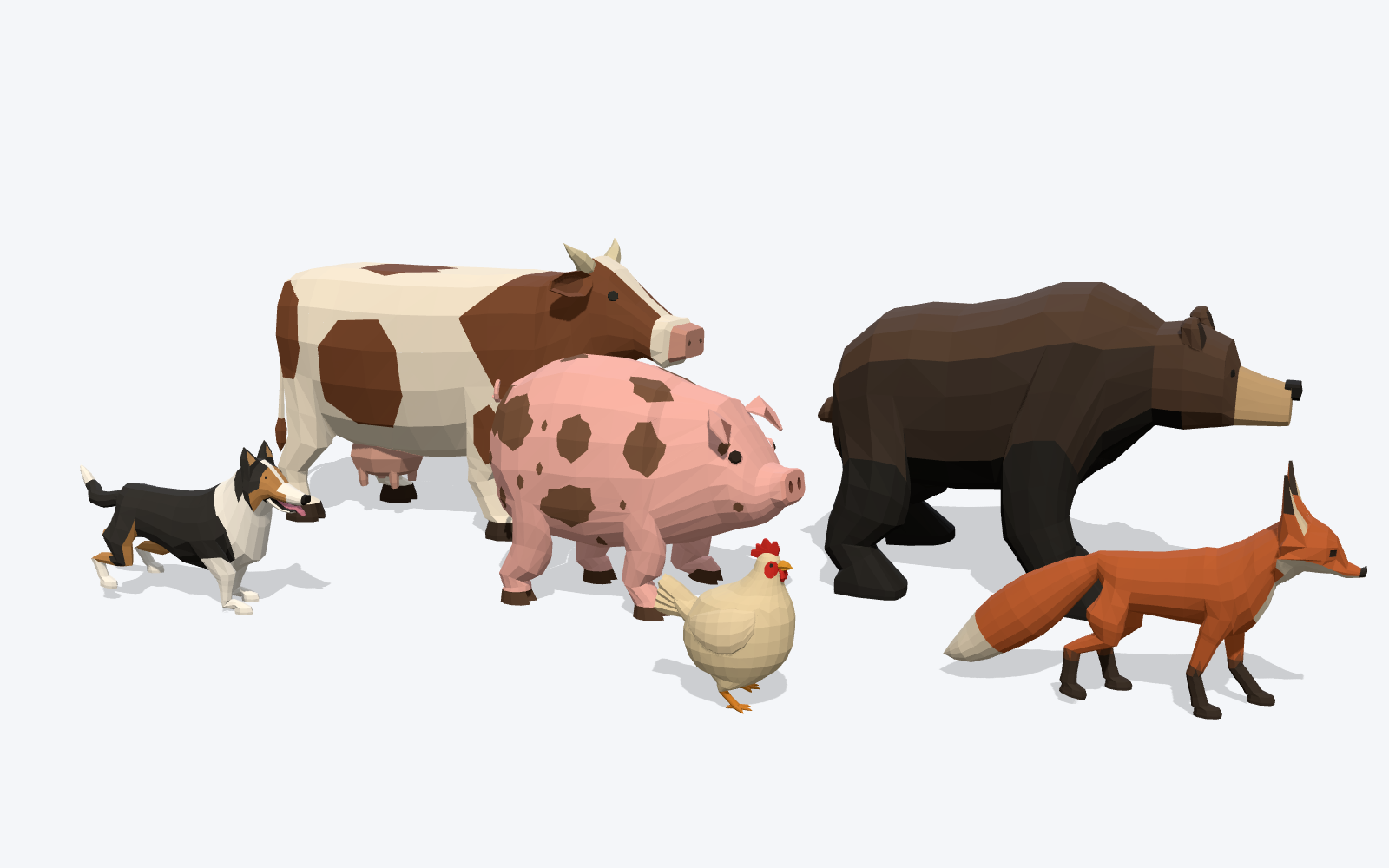
We won the XPRIZE. So every low poly model is free now.
Polyfork took first place, and $500,000, in the Build with Gemini XPRIZE. We are spending it on giving the low poly catalogue away: 2,742 models, downloadable with no account.

Polyfork won the Build with Gemini XPRIZE. On 25 September, on stage at Moonshots LIVE in Los Angeles, five finalists pitched to the judges, and we were awarded first place and $500,000. XPRIZE's announcement has every winner.
We are spending it on the obvious thing. Since 25 October every low poly model on Polyfork is free, and so is every new one: 2,742 today, and 1,069 of them published in the last 30 days. Anyone can download them as GLB, FBX, USD or OBJ without an account and put them in a commercial game. This post is the whole story: what the prize was, what we pitched, the film we made to say it, and the people we owe.
What the Build with Gemini XPRIZE was
It was a hackathon with a business test. Builders had 90 days to launch a new company run on AI and make real revenue with it, and the revenue was judged as money customers had actually paid inside the window, not as a demo or a forecast.
| Organised by | XPRIZE, presented by Gemini, with Google as technology partner and Devpost running the competition |
| The brief | 90 days to launch a new AI-native business that earns revenue |
| The field | more than 26,000 builders registered, across five categories |
| Judged on | business viability, AI-native operations and category impact, weighted equally |
| The final | five finalists pitching live at Moonshots LIVE, Los Angeles, 25 September 2026 |
| The judges | Cathie Wood (ARK Invest), Palmer Luckey (Anduril), Mark Pincus (Zynga) and Logan Kilpatrick (Google DeepMind). XPRIZE CEO Anousheh Ansari presented the awards |
| The prizes | $2 million in all: $500,000 for first, $200,000 for second, $100,000 each for third to fifth, and $50,000 category and runner-up awards |
Our part of it, in dates:
- 1 August. Polyfork launched, and made its first sale the same day.
- 17 August. We submitted, in the Small Business Services category, because the people paying us were small studios and solo developers.
- 20 September. We heard we were one of the five finalists.
- 25 September. One minute to introduce ourselves, two minutes to pitch, seven minutes of questions from the judges. Then first place.
XPRIZE's write-up describes Polyfork as a store that sells 3D models as programs, so buyers can resize, recolour and remix a model before downloading it, made by an AI-agent factory that publishes more than 175 models a week. It also gives our first month: a catalogue of 583 models, $4,428 in revenue, 54 paying customers.
What we pitched: models that are programs
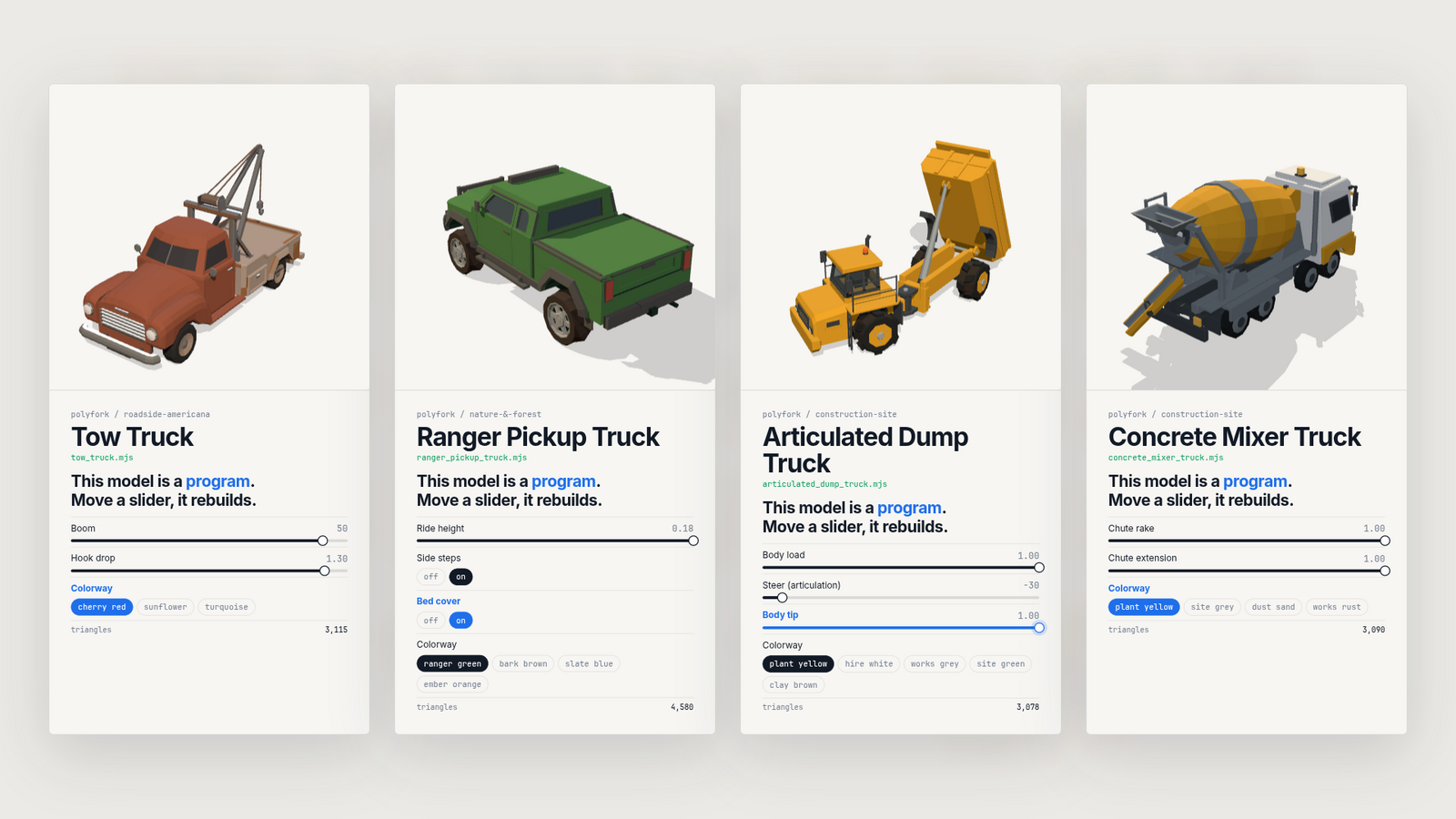
A 3D model is usually a file of frozen triangles. If the barn is too short, or the wrong red, you go back to whoever made it. Every Polyfork model is a small three.js program instead: it builds its mesh when you call it, and the decisions its maker took are still there as sliders. Across the catalogue that is 34,523 of them.
One line from the pitch: AI writes the games now. It cannot sculpt a barn. A coding agent asked for a farm game writes the game quickly, then spends most of its time and tokens building every barn and tree by hand. Agents speak code, and our models are code: an agent can import a barn, set its width and its roof colour, and move on.
The factory that makes the models runs on agents too, which is what the second criterion, AI-native operations, asked about. A planner turns one sentence about a kit into a list of parts. Gemini draws a reference picture of each part. A coding agent writes the program that builds it, a judge compares the render with Gemini's picture and sends the model back when it is not close enough, and a person looks at every model before it ships.
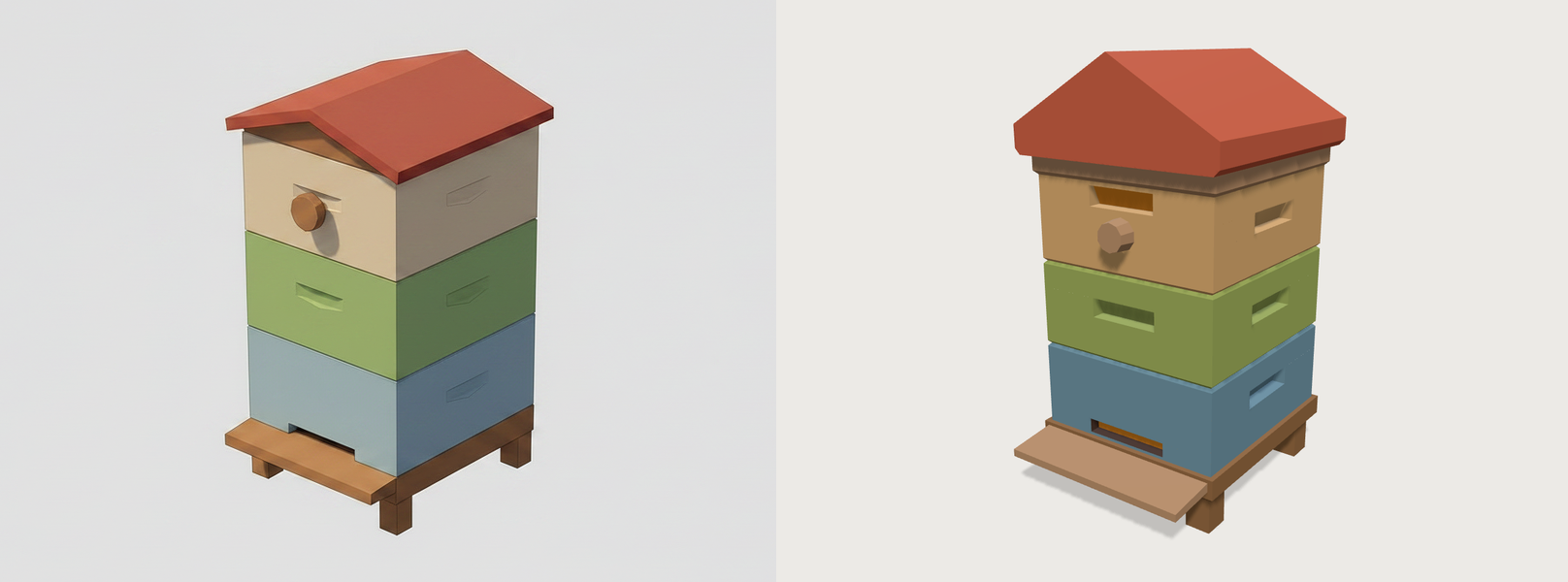
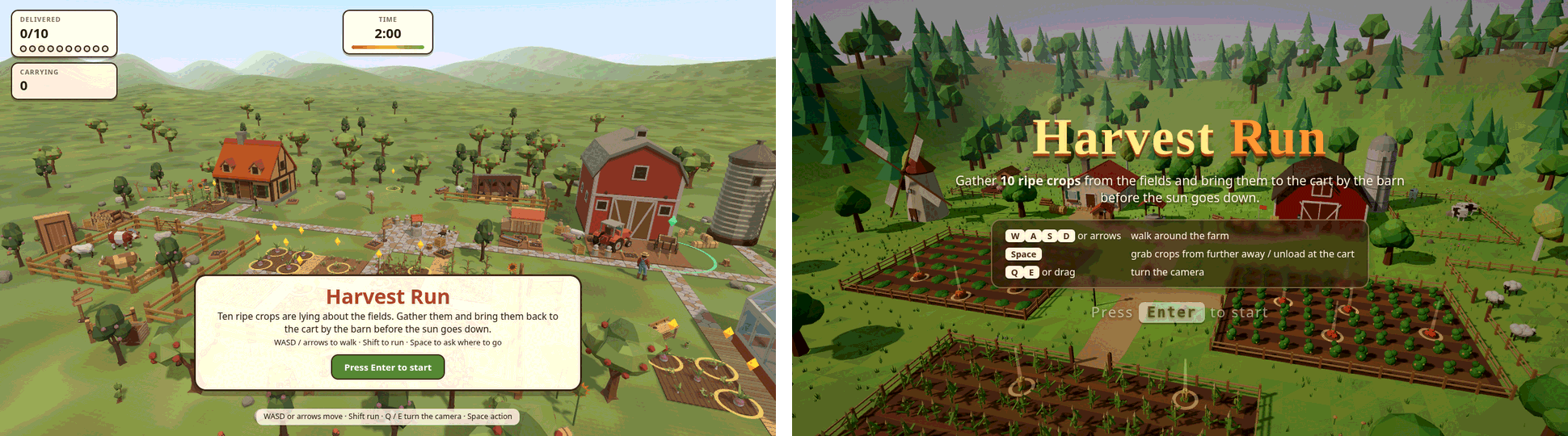
We also showed what that changes for an agent. Two coding agents got the same farm-game brief, one with Polyfork and one without. The one with Polyfork finished in 17 minutes rather than 28, cost $2.20 rather than $3.10, wrote 51,618 output tokens rather than 138,115, and three blind AI judges preferred its game, 3 to 0.
What the prize pays for: every low poly model, free
At the pitch, about half the catalogue was free and the rest was paid. The prize money pays for the factory, so the catalogue it makes can be given away. Since 25 October:
- Every low poly model is free, and every new one is free the day it ships. 2,742 today. Each is the same program it always was, with every slider.
- No account to download. GLB, FBX, USD and OBJ download for anyone, for Unity, Godot, Unreal, Blender or the web, and so does a whole kit's scene as one GLB.
- A free account for the source. The .mjs program and the zips ask you to sign in, and that is all they ask. Agents keep getting models through our MCP server and API, as before.
- Commercial use included. The licence is the one paid models always had: games, apps and client work, no attribution. The one thing it rules out is reselling the models as assets.
- What stays paid is HD. 1,483 models also come in an HD edition, high poly and textured, built from the same program. That is what Pro and Lifetime pay for now, and the HD shelf shows all of them.
The film we made to say it
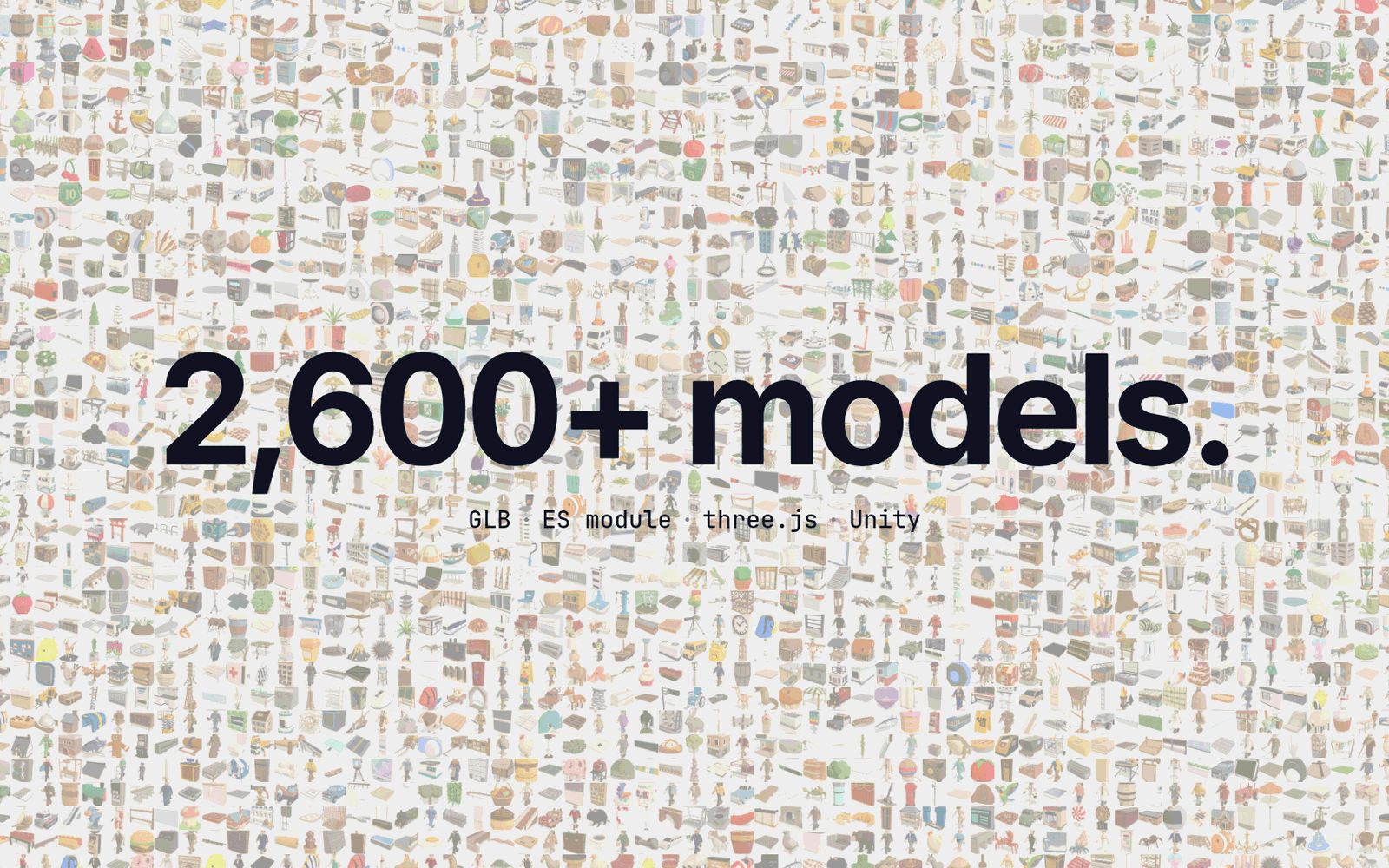
To announce it we made a film out of the store itself. Nothing in it is a mock-up. The wall at the start is every published model's thumbnail, the count runs to the real total, and every card that opens is the live model loaded from the store, with its sliders moving its real parameters.
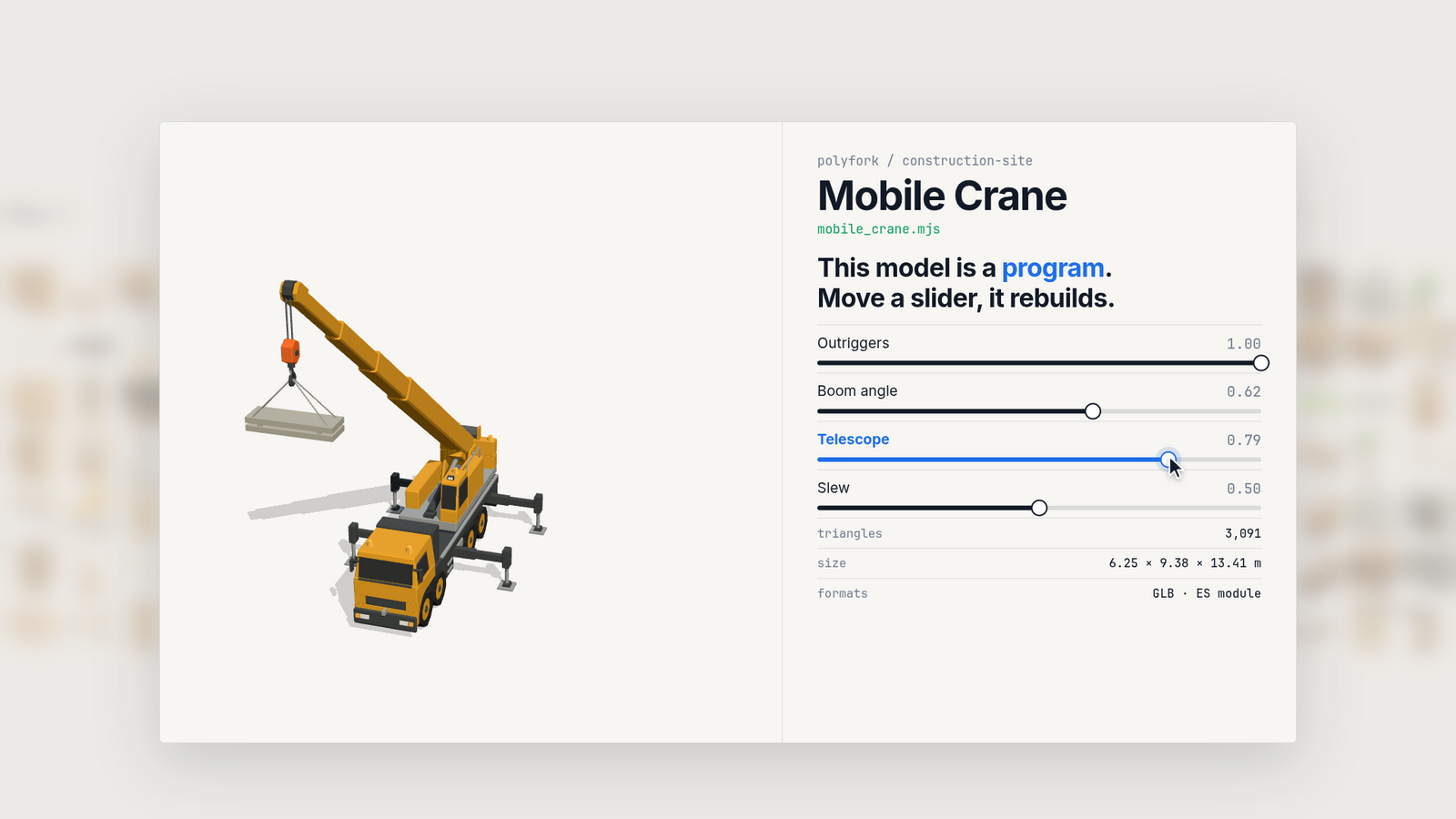
After a quick tour of six kits, the models open in waves: one, then two at once, then three, then four.
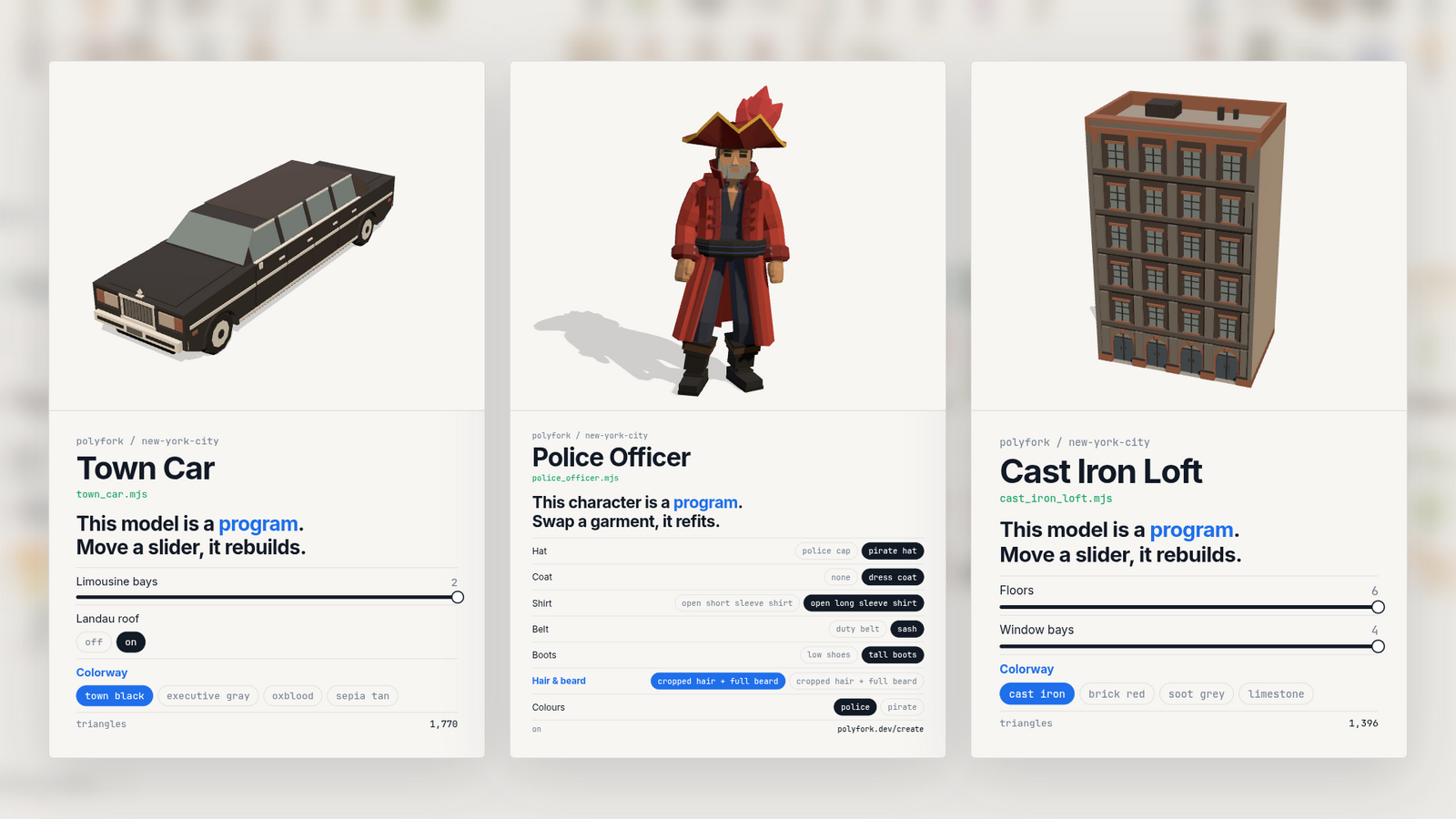
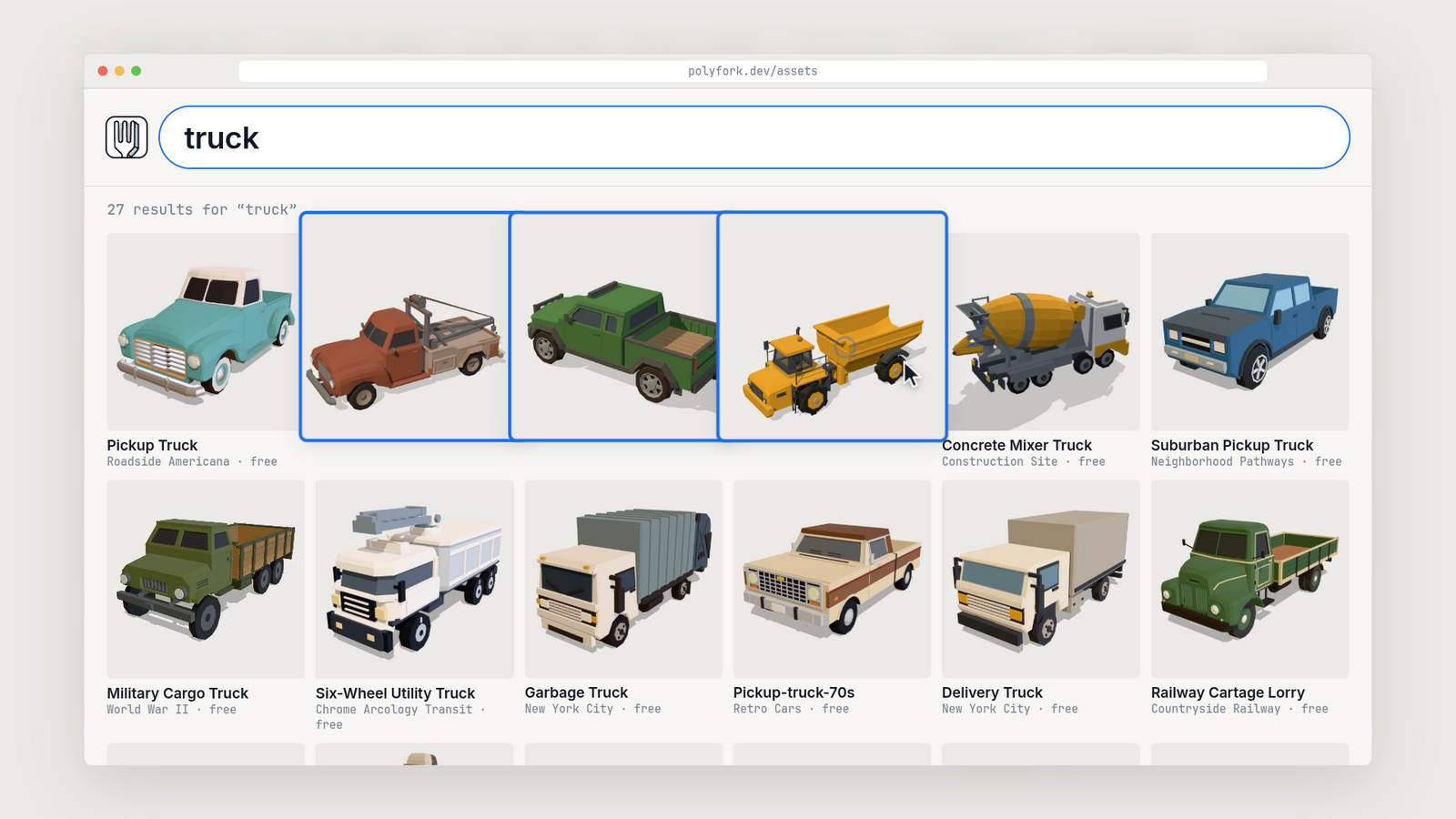
The last wave starts from a search, the way anybody would start: a browser window opens, truck is typed, and four results are picked.
Thank you
Prize posts usually thank the jury first. We want to start with the people who paid before any of this happened.
- Everyone who bought a Lifetime seat. You backed Polyfork when it cost money and nobody knew whether it would work, and that is a big part of why it did. We wrote to all 152 of you on 26 October. In short: nothing you paid for goes away, and your seat keeps the HD.
- Every Pro subscriber, and every customer since 1 August. And everyone who asked for a model on /requests or told us one was wrong: the catalogue is shaped by those messages more than by anything we planned.
- XPRIZE, for a prize that judged businesses on real customers. Thank you to Anousheh Ansari, to Peter Diamandis and the Moonshots LIVE team, and to Devpost for running the competition.
- Google and the Gemini team, for presenting the prize, and for the model that draws the reference every part in our factory is judged against.
- The judges, Cathie Wood, Palmer Luckey, Mark Pincus and Logan Kilpatrick, for their time and their questions.
- The other finalists, Tician Cierre, MyFixAm, Launchbridge and DodoPrep, and every winner on XPRIZE's list. Congratulations.
The low poly catalogue belongs to everyone now, and it stays free for good: every model the factory finishes joins it the day it ships. Let's go build.
Frequently asked questions
Did Polyfork win the Build with Gemini XPRIZE?
Yes. Polyfork took first place and $500,000 in the Build with Gemini XPRIZE. The five finalists pitched live at Moonshots LIVE in Los Angeles on 25 September 2026, in front of Cathie Wood, Palmer Luckey, Mark Pincus and Logan Kilpatrick.
Are Polyfork's 3D models free now?
Every low poly model is free, 2,742 of them today, and every new one is free the day it is published. The HD editions, high poly and textured, are what the Pro and Lifetime plans pay for.
Do I need an account to download a free model?
No. GLB, FBX, USD and OBJ files, and a kit's scene as one GLB, download without an account. The .mjs source program and the zip downloads need a free account.
Can I use the free models in a commercial game?
Yes. Free models carry the same licence as paid ones: use them in commercial games, apps and client work, with no attribution. You may not resell or redistribute them as assets, or use them to build a commercial 3D asset generator.
What does Gemini do in Polyfork?
Gemini draws the reference picture for every part a kit needs. Coding agents write the program that builds each model, a judge compares its render with that picture and sends it back when it falls short, and a person approves every model before it ships.